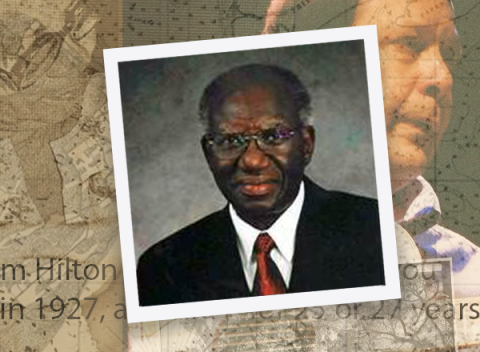

Education remains a hallmark of the White family. For Perry White, that meant leaving home to attend high school. He was a boarding student at the Penn School on St. Helena Island, graduating in 1952 in a class of 17. After a 20-year career in the Air Force, he returned to the island in 1973 with his wife, Barbara, and four daughters. “We saw the progress here over the years,” he said about returning home. “If not for the progress, we would not have come back here. ... We would’ve gone some place with better schools and better job opportunities.” He became a business manager with Beaufort-Jasper Comprehensive Health Services.
Perry White never stepped back from fighting for a just cause including fighting the incorporation of the Town of Hilton Head Island, fighting for land-use rights for native islanders, fighting encroachment on his church and neighborhood by the expanding Hilton Head Airport, promoting the Gullah culture and pressing for public acknowledgment and preservation of its prominent position in island and American history. He was a charter member of the island’s Human Relations Council, founded in the 1970s to encourage informal meetings and discussion of issues between island natives and the newcomers.
He was a founder of the Ella C. White Scholarship Fund, created to honor a teacher in his family by awarding college scholarships to local graduates. In his later years, he was a ring-leader in creating the Arthur E. Wiley American Legion Post 42 on Hilton Head.
Mr. White was a businessman. He and Barbara ran a Gullah Flea Market for about 15 years on U.S. 278 across from the Squire Pope Road intersection. It opened as a farmer’s market, was highly visible, and was seen as a bellwether business for the Gullah culture and native island community. It was a place were artisans worked, including sweetgrass basket weavers. White sold the 4.9-acre site to the town and retired in 2003.
His life reflects a quotation he shared the day a historical marker was dedicated at the old Gullah Cherry Hill School in his native Baygall community: “In the words of an old Negro hymn, ‘It was a tejus (tedious) journey.’ “